
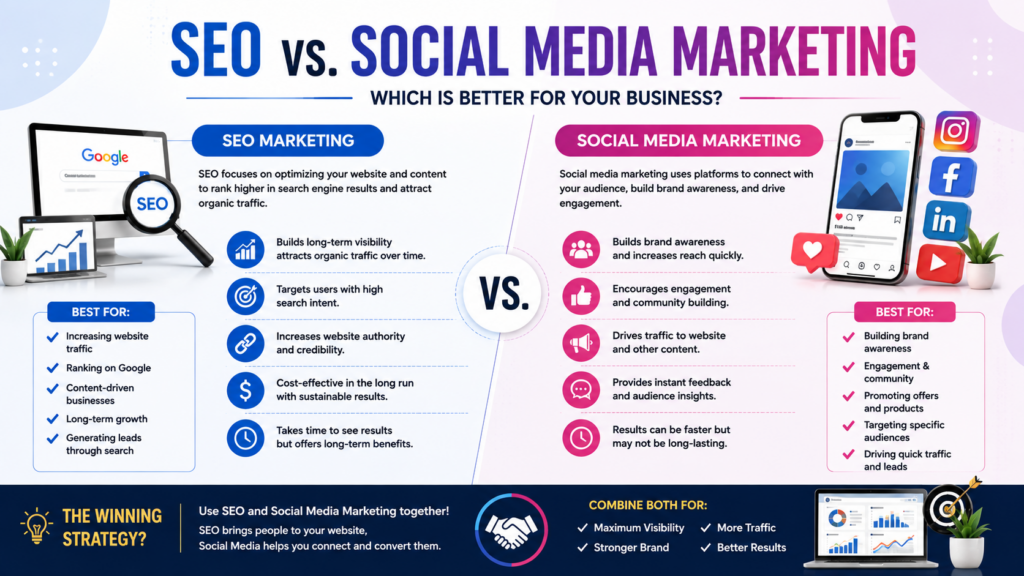
SEO vs. Social Media Marketing: Which Is Better for Your Business?
Primary Keyword: SEO vs Social Media Marketing
Secondary Keywords: SEO Marketing, Social Media Marketing, SEO Strategy, Social Media Strategy, Digital Marketing, Online Marketing
Introduction
In today’s digital world, businesses need a strong online presence to attract customers and grow their brand. Two of the most popular digital marketing channels are SEO (Search Engine Optimization) and social media marketing.
But which one is better for your business?
The answer depends on your goals, target audience, industry, budget, and marketing strategy. SEO marketing can help your website attract organic traffic from search engines, while social media marketing can help you build brand awareness, engage with your audience, and promote your content.
Rather than choosing only one, many businesses can benefit from using SEO and social media marketing together.
In this guide, we’ll compare SEO vs. social media marketing, explain their benefits and differences, and help you decide which strategy may be right for your business.
What Is SEO Marketing?
Search Engine Optimization (SEO) is the process of optimizing a website and its content to improve its visibility in organic search engine results.
When people search for information, products, or services online, search engines try to provide the most relevant results.
For example, someone may search for:
“Best digital marketing tips for beginners”
An SEO-optimized blog post targeting that topic may have an opportunity to appear in search results.
SEO typically includes:
- Keyword research
- On-page SEO
- Technical SEO
- Content optimization
- Internal linking
- Image optimization
- Website performance
- Local SEO
- Earning relevant backlinks
What Is Social Media Marketing?
Social media marketing is the use of social media platforms to promote a business, product, service, or brand and connect with a target audience.
Businesses can use social media to:
- Build brand awareness
- Engage with customers
- Share content
- Promote products and services
- Drive website traffic
- Generate leads
- Build an online community
Popular social media content formats include:
- Reels
- Videos
- Carousels
- Images
- Stories
- Live streams
- Educational posts
SEO vs. Social Media Marketing: Key Differences
Although both are digital marketing strategies, SEO and social media marketing work differently.
| SEO Marketing | Social Media Marketing |
|---|---|
| Focuses on search engines | Focuses on social platforms |
| Primarily attracts search-based traffic | Primarily builds audience and engagement |
| Often a long-term strategy | Can generate faster audience interaction |
| Focuses heavily on search intent | Focuses heavily on interests and engagement |
| Drives traffic to websites | Can drive traffic to websites and profiles |
| Builds organic search visibility | Builds social presence and brand awareness |
| Requires website and content optimization | Requires consistent social content |
Neither strategy is automatically better. Each serves a different purpose.
Benefits of SEO Marketing
1. Generates Organic Traffic
SEO can help your website attract people who are actively searching for information related to your products, services, or industry.
This can be valuable because search users often have a specific need or question.
2. Builds Long-Term Visibility
A well-optimized piece of content can continue attracting organic visitors over time.
For example, an informative blog post can potentially generate search traffic long after it is published.
However, rankings are not guaranteed, and content may need to be updated as search results and user needs change.
3. Targets Search Intent
SEO allows you to create content around specific searches.
For example:
Informational:
“What is SEO?”
Commercial:
“Best SEO tools for small businesses”
Transactional:
“SEO services”
Understanding search intent helps businesses create content that matches what users are looking for.
4. Builds Website Authority
Consistently publishing useful and relevant content can help establish your website as a valuable resource within your industry.
5. Supports Local Businesses
Local SEO can help businesses become more visible for searches related to their location.
Examples include:
- Digital marketer near me
- SEO agency in [City]
- Best café in [Location]
- Marketing services near me
Benefits of Social Media Marketing
1. Builds Brand Awareness
Social media can introduce your brand to people who may not be actively searching for your products or services.2. Creates Direct Engagement
Unlike search engines, social platforms provide opportunities for direct interaction through:
- Comments
- Messages
- Polls
- Questions
- Stories
- Live sessions
This can help businesses build relationships with their audience.
3. Supports Content Distribution
A blog post published on your website can be promoted through social media.
For example:
SEO Blog → Instagram Carousel → LinkedIn Post → Short Video → Website Traffic
This allows one piece of content to reach audiences across multiple channels.
4. Provides Fast Feedback
Social media can make it easier to see how people react to your content.
Likes, comments, shares, saves, views, and messages can provide useful audience feedback.
5. Helps Build a Community
Social media can help brands create communities around shared interests, products, services, or ideas
SEO vs. Social Media Marketing: Which Is Better?
There is no universal winner.
The better strategy depends on your business goals.
Choose SEO If Your Goal Is:
- Increasing organic website traffic
- Reaching people actively searching for your services
- Building long-term search visibility
- Creating educational content
- Targeting specific keywords
- Generating search-based leads
- Growing website authority
For example, a digital marketing website publishing educational blogs may benefit significantly from SEO.
Choose Social Media Marketing If Your Goal Is:
- Building brand awareness
- Growing an online community
- Engaging with your audience
- Promoting visual content
- Increasing social engagement
- Sharing short-form videos
- Building a personal brand
For example, a personal digital marketer may use Instagram and LinkedIn to share marketing tips, personal insights, and educational content.
SEO vs. Social Media Marketing for Small Businesses
Small businesses often have limited time and marketing budgets.
Instead of trying to dominate every channel, start by choosing strategies that match your audience.
SEO can be useful when:
Your customers regularly search Google for products, services, or solutions.
Social media can be useful when:
Your audience spends significant time on social platforms and responds well to visual or interactive content.
A combination can be powerful when:
You want to build both search visibility and an engaged audience.
SEO vs. Social Media Marketing for Personal Brands
Personal brands can benefit from both channels.
For example, a digital marketer can use:
SEO to publish detailed articles and attract search traffic.
Instagram to share reels, carousels, and quick marketing tips.
LinkedIn to share professional insights and industry knowledge.
YouTube to publish detailed tutorials.
This creates a multi-channel digital marketing strategy.
How SEO and Social Media Work Together
SEO and social media should not necessarily be treated as competitors.
They can support each other.
A simple strategy could look like this:
Step 1: Create SEO-Optimized Content
Write a helpful blog targeting a relevant search topic.
Step 2: Publish It on Your Website
Optimize the title, headings, keywords, images, internal links, and user experience.
Step 3: Promote the Content on Social Media
Turn the blog into:
- Instagram carousel
- Reel
- LinkedIn post
- Facebook post
- YouTube Short
Step 4: Drive People to Your Website
Use relevant calls-to-action to encourage users to read the complete article.
Step 5: Analyze Performance
Monitor website traffic, search visibility, social engagement, clicks, and conversions.
This creates a connected digital marketing strategy rather than treating each channel separately.
SEO vs. Social Media Marketing: Cost
Both SEO and social media marketing can be performed with different budget levels.
SEO Costs Can Include:
- SEO tools
- Content creation
- Website development
- Technical SEO
- Professional SEO services
- Content promotion
Social Media Costs Can Include:
- Content creation
- Graphic design
- Video production
- Social media management
- Influencer collaborations
- Paid advertising
You can start both strategies organically and invest more as your business grows.
SEO vs. Social Media Marketing: Time to See Results
One of the biggest differences is the way results typically develop.
SEO
SEO generally requires patience. Competitive keywords can take time to gain visibility, while well-targeted content may begin generating traffic sooner.
Social Media
Social media can generate engagement and reach relatively quickly, but consistent growth and community building also require time and effort.
Neither channel guarantees results.
Success depends on content quality, competition, audience, consistency, strategy, and execution.
Important Metrics to Track
Different channels require different performance metrics.
SEO Metrics
Track:
- Organic traffic
- Search impressions
- Click-through rate
- Keyword visibility
- Organic conversions
- Indexed pages
- Backlinks
Social Media Metrics
Track:
- Reach
- Impressions
- Engagement
- Video views
- Saves
- Shares
- Follower growth
- Website clicks
- Leads
Don’t focus on vanity metrics alone. Connect your metrics to actual business goals.
Common Mistakes to Avoid
SEO Mistakes
- Keyword stuffing
- Creating low-quality content
- Ignoring search intent
- Poor website structure
- Slow website performance
- Ignoring mobile usability
- Using irrelevant backlinks
Social Media Mistakes
- Posting without a strategy
- Focusing only on follower numbers
- Posting overly promotional content
- Ignoring comments and messages
- Inconsistent branding
- Not analyzing performance
A Simple Strategy for Beginners
If you’re just starting digital marketing, you don’t need a complicated strategy.
Step 1: Build Your Website
Create a professional, mobile-friendly website.
Step 2: Start SEO
Research relevant keywords and publish helpful content.
Step 3: Choose One Social Platform
Start with the platform where your target audience is most active.
Step 4: Repurpose Your Content
Turn each blog post into multiple social media posts.
Step 5: Track Results
Monitor website traffic, search performance, social engagement, and conversions.
Step 6: Improve
Use your results to identify what works and focus more on those strategies.
SEO + Social Media Marketing: The Best Approach
Instead of asking:
“SEO or social media marketing?”
a better question is:
“How can SEO and social media work together to achieve my business goals?”
SEO can help people find you when they search.
Social media can help people discover, engage with, and remember your brand.
Together, they can create a stronger digital marketing ecosystem.
Conclusion
SEO vs. social media marketing is not necessarily a competition. Both strategies have different strengths and can play important roles in a successful digital marketing plan.
SEO is particularly useful for building organic search visibility, attracting search-driven traffic, and creating long-term website value.
Social media marketing is particularly useful for building brand awareness, engaging audiences, distributing content, and developing an online community.
For many businesses and personal brands, the best approach is to use SEO and social media marketing together.
Create valuable SEO-optimized content, promote it through social media, engage with your audience, measure the results, and continuously improve your strategy.
SEO helps people find your content. Social media helps you connect with people. Together, they can help your brand grow online.