
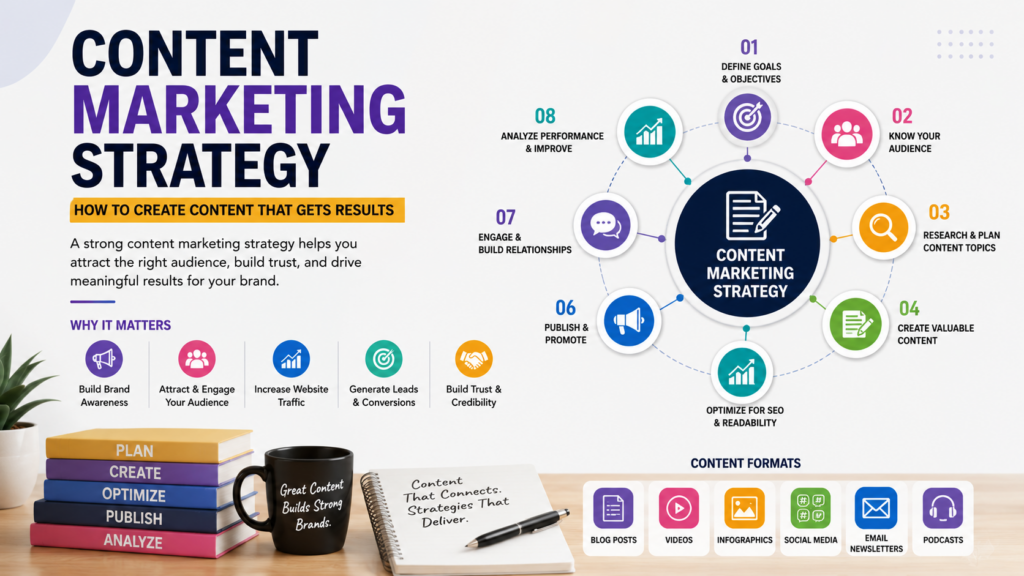
In today’s competitive digital world, creating content is one of the most effective ways to attract an audience, build brand awareness, and grow an online presence. However, simply publishing blog posts, social media posts, or videos does not guarantee results.
A successful content marketing strategy starts with understanding your audience, defining clear goals, creating valuable content, and measuring performance. When content is created with a purpose, it can help businesses attract potential customers, build trust, increase website traffic, and support conversions.
In this guide, we will explore what content marketing is, why it is important, how to create a content marketing strategy, and practical content creation tips that can help your business get better results.
What Is Content Marketing?
Content marketing is a digital marketing approach that involves creating and distributing valuable, relevant, and consistent content to attract and engage a specific target audience.
Instead of focusing only on direct promotion, content marketing aims to provide useful information that helps people solve problems, answer questions, or make better decisions.
Examples of content marketing include:
- Blog posts
- Videos
- Social media posts
- Infographics
- Case studies
- E-books
- Guides
- Email newsletters
- Podcasts
- Tutorials
For example, a digital marketer could create a blog titled “10 Effective SEO Strategies to Improve Your Website Ranking” to help beginners learn about SEO while attracting people interested in digital marketing.
Why Is Content Marketing Important?
A strong content marketing strategy can support several important business goals.
1. Builds Brand Awareness
Publishing useful content can introduce your brand to new audiences.
When people repeatedly discover helpful content from your website or social media channels, they may become more familiar with your brand.
2. Increases Website Traffic
SEO-optimized blog posts can attract people searching for information through search engines.
For example, an article targeting the keyword “content marketing strategy” can potentially attract users who are actively looking for information about content marketing.
Social media can also help distribute your content and encourage people to visit your website.
3. Builds Trust and Credibility
Helpful content can demonstrate your knowledge and expertise.
Instead of simply telling your audience that you understand digital marketing, you can demonstrate your knowledge by publishing:
- Educational guides
- Case studies
- Tutorials
- Industry insights
- Practical tips
This can help establish your website as a useful resource.
4. Supports SEO
Content marketing and SEO work closely together.
Creating useful, search-focused content gives search engines more relevant pages to discover and potentially rank.
A strong content strategy can include:
- Keyword research
- Search intent analysis
- SEO-friendly titles
- Structured headings
- Internal links
- Helpful content
- Optimized images
5. Generates Leads
Content can guide potential customers through different stages of their decision-making process.
For example:
Blog Post → Valuable Information → Website Visit → Call-to-Action → Inquiry
A well-designed content strategy can turn useful information into opportunities for generating leads.
Content Marketing vs Traditional Advertising
Traditional advertising usually focuses on directly promoting a product, service, or brand.
Content marketing focuses more heavily on providing value before asking the audience to take action.
| Content Marketing | Traditional Advertising |
|---|---|
| Educational | Promotional |
| Builds long-term value | Often campaign-focused |
| Answers customer questions | Promotes an offer |
| Supports SEO | Usually doesn’t rely on organic search |
| Builds audience relationships | Focuses on reaching an audience |
Both approaches can be useful, but content marketing provides opportunities to build an ongoing library of valuable resources.
How to Create a Content Marketing Strategy
A successful content marketing strategy requires planning.
Step 1: Define Your Goals
Start by deciding what you want your content to achieve.
Common content marketing goals include:
- Increase website traffic
- Improve SEO visibility
- Build brand awareness
- Generate leads
- Increase engagement
- Educate your audience
- Support sales
- Build authority
Your content should have a clear purpose.
Step 2: Identify Your Target Audience
You need to understand who you are creating content for.
Consider:
- Age group
- Interests
- Problems
- Goals
- Questions
- Buying behavior
- Preferred content formats
For example, if your audience consists of beginners interested in digital marketing, you may want to create simple guides rather than highly technical articles.
Step 3: Research Your Audience’s Questions
One of the best ways to create useful content is to understand what your audience wants to know.
Look for:
- Frequently asked questions
- Common problems
- Search queries
- Industry discussions
- Customer feedback
- Competitor content gaps
This can help you create content that addresses real audience needs.
Step 4: Perform Keyword Research
If SEO is one of your goals, keyword research should be part of your content planning.
For example, a digital marketing website could target keywords such as:
- Digital marketing
- SEO strategies
- Content marketing
- Social media marketing
- Content marketing strategy
- SEO tips
- Digital marketing tips
Don’t simply choose keywords because they have high search volume. Consider whether the keyword is relevant to your audience and whether your content can genuinely satisfy the search intent.
Step 5: Choose Your Content Formats
Different audiences prefer different content formats.
Your content strategy can include:
Blog Posts
Useful for detailed educational information and SEO.
Videos
Useful for tutorials, demonstrations, explanations, and engaging storytelling.
Social Media Posts
Useful for quick tips, educational content, announcements, and audience engagement.
Infographics
Useful for presenting statistics, processes, and complex information visually.
Case Studies
Useful for demonstrating strategies, processes, and outcomes.
E-books and Guides
Useful for providing detailed information and generating leads.
Step 6: Create Content Pillars
Content pillars are the main topics that your brand consistently discusses.
For a digital marketing website, content pillars could include:
SEO
Topics about:
- Keyword research
- On-page SEO
- Technical SEO
- Website optimization
- Search rankings
Social Media Marketing
Topics about:
- Social media strategy
- Instagram marketing
- Content ideas
- Engagement
- Social media growth
Content Marketing
Topics about:
- Content strategy
- Blogging
- Content creation
- Content planning
- Content promotion
Digital Marketing
Topics about:
- Digital marketing basics
- Marketing strategies
- Online advertising
- Lead generation
- Marketing trends
Content pillars help keep your website focused and organized.
Step 7: Create a Content Calendar
A content calendar helps you plan and publish consistently.
For example:
| Day | Content Type | Topic |
| Monday | Blog | SEO Strategy |
| Tuesday | Instagram Reel | Marketing Tip |
| Wednesday | Carousel | Content Marketing |
| Thursday | Story | Audience Question |
| Friday | Blog | Social Media Marketing |
| Saturday | Video | Digital Marketing Tutorial |
| Sunday | Post | Weekly Marketing Tip |
You can change the schedule based on your available time and audience behavior.
Step 8: Optimize Content for SEO
Creating valuable content is important, but making it easy for search engines to understand is also useful.
Basic SEO practices include:
Use a Clear Title
Include the primary keyword naturally in the page title when appropriate.
Use Headings
Break your article into logical H2 and H3 sections.
Add Internal Links
Link to relevant articles and pages on your website.
Optimize Images
Use descriptive image file names and useful alt text.
Match Search Intent
Make sure the content answers the question behind the user’s search.
Write Naturally
Avoid excessive keyword repetition. Your content should sound natural and be written primarily for readers.
Step 9: Promote Your Content
Publishing content is only part of the process.
You also need to distribute it.
Content promotion can include:
- Social media marketing
- Email newsletters
- Community engagement
- Internal website links
- Video promotion
- Relevant partnerships
- Search engine optimization
For example, one blog post can be transformed into several social media posts, a short video, and an infographic.
Content Repurposing: Create More From One Idea
Content repurposing means transforming one piece of content into multiple formats.
For example, this blog post about content marketing strategy could become:
Blog Post
↓
Instagram Carousel
↓
Short Video/Reel
↓
LinkedIn Post
↓
Infographic
↓
Email Newsletter
This approach can save time while helping you reach people across multiple platforms.
10 Content Marketing Tips
1. Focus on Quality
One useful, well-researched article can be more valuable than several low-quality posts.
2. Solve a Problem
Create content that helps your audience solve a specific problem.
3. Use Simple Language
Make your content easy to understand, especially when targeting beginners.
4. Add Examples
Examples make complex marketing concepts easier to understand.
5. Be Consistent
Create a realistic publishing schedule that you can maintain.
6. Use Visual Content
Images, videos, charts, and infographics can improve the presentation of your content.
7. Add Clear Calls-to-Action
Tell readers what they can do next.
Examples:
- Read another article
- Contact us
- Subscribe
- Learn more
- Download a guide
8. Update Existing Content
Review older content periodically and update information when needed.
9. Track Performance
Monitor traffic, engagement, rankings, and conversions.
10. Learn From Your Audience
Use comments, questions, analytics, and feedback to discover what content your audience finds useful.
Important Content Marketing Metrics
Measuring performance helps you understand whether your strategy is working.
Website Traffic
Shows how many people visit your content.
Organic Traffic
Measures visitors coming from search engines.
Engagement
Shows how people interact with your content.
Time on Page
Can provide insight into whether visitors are spending time reading your content.
Leads
Shows whether content is helping generate potential customers.
Conversions
Measures whether visitors complete important actions.
Keyword Rankings
Helps track your visibility in search results for target keywords.
Common Content Marketing Mistakes
Avoid these mistakes when developing your content strategy:
Creating Content Without a Goal
Every piece of content should have a clear purpose.
Writing Only for Search Engines
SEO is important, but content should primarily help real people.
Copying Competitor Content
Your content should provide original value and a unique perspective.
Publishing Without Consistency
Irregular publishing can make it difficult to build a reliable content library.
Ignoring Promotion
Even excellent content may struggle to reach an audience if nobody knows it exists.
Not Measuring Results
Without analytics, it is difficult to understand what content performs best.
How Long Does Content Marketing Take to Work?
Content marketing is generally a long-term strategy.
The time required to see meaningful results depends on factors such as:
- Website authority
- Competition
- Content quality
- SEO strategy
- Publishing consistency
- Industry
- Audience
- Content promotion
Some content may attract visitors quickly, while other articles may take months to gain search visibility.
Instead of focusing only on immediate results, build a useful library of content that continues to provide value over time.
A Simple Content Marketing Strategy for Beginners
If you are just getting started, follow this simple process:
Month 1: Research
- Define your audience.
- Choose your content topics.
- Research keywords.
- Identify content gaps.
- Create your content calendar.
Month 2: Create
- Publish helpful blog posts.
- Create social media content.
- Optimize your website.
- Add internal links.
- Repurpose content.
Month 3: Analyze
- Review website traffic.
- Check keyword performance.
- Analyze social engagement.
- Identify your best-performing topics.
- Improve older content.
This creates a simple foundation for long-term content marketing growth.
Conclusion
A successful content marketing strategy is about more than simply publishing articles or social media posts. It requires a clear understanding of your audience, well-defined goals, useful content, SEO optimization, consistent publishing, effective promotion, and regular performance analysis.
The best content answers questions, solves problems, educates readers, and provides genuine value.
Whether you are building a personal brand, small business website, or professional digital marketing website, content marketing can help you attract the right audience and build a stronger online presence.
Start with one topic, create valuable content, promote it across relevant channels, measure the results, and continuously improve your strategy.
Create valuable content. Build trust. Grow your audience.