
Introduction
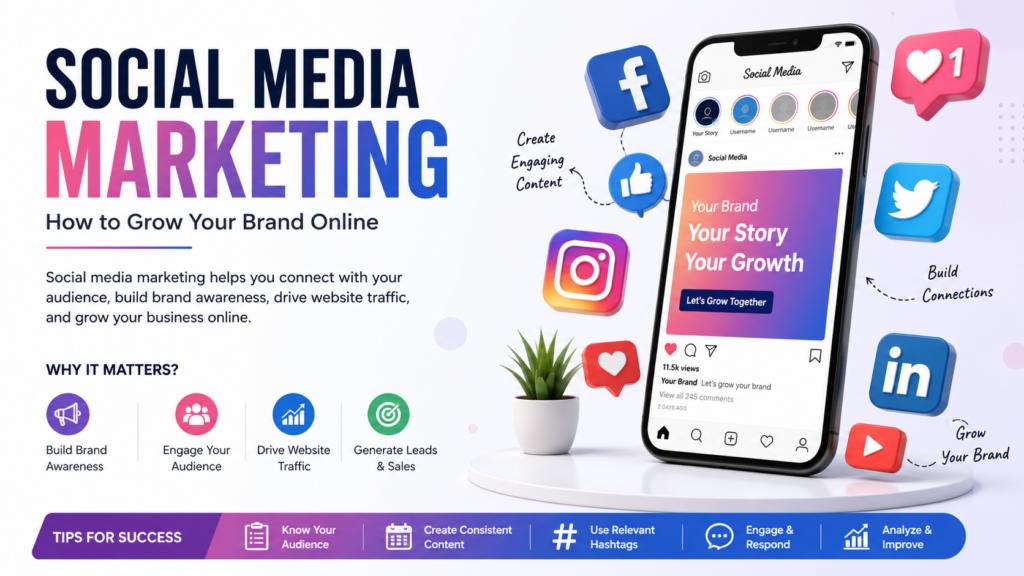
Social media has become one of the most powerful channels for businesses to connect with their target audience. From Instagram and Facebook to LinkedIn, YouTube, and other platforms, social media gives brands opportunities to build awareness, share valuable content, engage with customers, and grow their online presence.
However, simply creating a social media account and posting occasionally is not enough. A successful social media marketing strategy requires clear goals, consistent content, audience research, and regular performance analysis.
In this guide, you will learn what social media marketing is, why it matters, how to create a social media strategy, and practical social media marketing tips to help grow your brand online.
What Is Social Media Marketing?
Social media marketing is the use of social media platforms to promote a brand, product, service, or business and connect with a target audience.
Businesses can use social media marketing to:
- Increase brand awareness
- Build relationships with customers
- Generate website traffic
- Promote products and services
- Generate leads
- Increase engagement
- Build an online community
- Support sales and conversions
Social media marketing can be used by small businesses, personal brands, startups, creators, and established companies.
Why Is Social Media Marketing Important?
A strong social media presence can help your brand stay visible and connected with its audience.
1. Builds Brand Awareness
Regularly sharing useful and engaging content can help people discover your brand and become familiar with what you offer.
For example, a digital marketing brand can share:
- SEO tips
- Marketing statistics
- Educational reels
- Digital marketing guides
- Industry updates
- Case studies
Over time, consistent content can help establish brand recognition.
2. Helps You Reach Your Target Audience
Social media platforms provide opportunities to reach specific groups of people based on interests, demographics, location, and behavior.
Instead of trying to communicate with everyone, you can create content specifically for the people who are most likely to be interested in your brand.
3. Increases Customer Engagement
Social media is not only a promotional channel. It is also a communication platform.
Businesses can interact with their audience through:
- Comments
- Direct messages
- Stories
- Polls
- Questions
- Live videos
- Community posts
Responding to your audience can help create stronger relationships and trust.
4. Drives Website Traffic
Social media can be used to introduce people to your website.
For example, you can share a blog post on Instagram, LinkedIn, Facebook, or other relevant platforms and encourage your audience to read the complete article on your website.
This creates a connection between your social media content and your website.
5. Supports Lead Generation
Social media can help businesses generate potential customers through:
- Contact forms
- Direct messages
- Landing pages
- Lead-generation campaigns
- Free resources
- Product inquiries
The key is to provide a clear next step for interested users.
Popular Social Media Marketing Platforms
Different platforms attract different audiences and content styles. Your business does not necessarily need to be active on every platform.
Instagram is highly visual and works well for:
- Reels
- Carousels
- Stories
- Product showcases
- Educational content
- Personal branding
It can be especially useful for brands that depend heavily on visual communication.
Facebook can be useful for:
- Community building
- Business pages
- Local businesses
- Groups
- Video content
- Customer communication
It can also support local marketing and customer engagement.
LinkedIn is particularly useful for professional and B2B marketing.
Businesses can share:
- Industry insights
- Educational articles
- Business updates
- Case studies
- Professional tips
- Company achievements
For a digital marketer, LinkedIn can be a useful platform for demonstrating expertise.
YouTube
YouTube is a powerful platform for long-form and short-form video content.
You can create:
- Tutorials
- Educational videos
- Product demonstrations
- Reviews
- Interviews
- Case studies
- YouTube Shorts
Video content can also support your overall content marketing strategy.
How to Create a Social Media Marketing Strategy
A successful social media strategy starts with planning.
Step 1: Define Your Goals
Before posting content, decide what you want to achieve.
Common social media goals include:
- Increase brand awareness
- Grow followers
- Increase engagement
- Generate leads
- Drive website traffic
- Increase sales
- Build an online community
Your goals should be specific and measurable.
Step 2: Understand Your Target Audience
Knowing your audience is essential.
Ask questions such as:
- Who are they?
- What problems do they have?
- What type of content do they enjoy?
- Which platforms do they use?
- What questions do they frequently ask?
- What motivates them to take action?
For example, if your target audience is beginners interested in digital marketing, educational and easy-to-understand content may perform better than highly technical content.
Step 3: Choose the Right Platforms
You don’t need to be everywhere.
Start with platforms where your target audience is most active.
For example:
| Platform | Suitable Content |
|---|---|
| Reels, carousels, stories | |
| Posts, videos, communities | |
| Professional posts, articles | |
| YouTube | Tutorials, educational videos |
| Visual guides and inspiration |
Choose one or two platforms initially and focus on creating high-quality content consistently.
Step 4: Create Content Pillars
Content pillars are the main topics you regularly talk about.
For a digital marketing website, your content pillars could include:
SEO
Share:
- SEO tips
- Keyword research ideas
- On-page SEO information
- Website optimization tips
Social Media Marketing
Share:
- Social media tips
- Content ideas
- Instagram strategies
- Engagement tips
Content Marketing
Share:
- Blogging tips
- Content strategy
- Content ideas
- Writing techniques
Digital Marketing Education
Share:
- Marketing basics
- Digital marketing definitions
- Industry trends
- Beginner guides
Content pillars make it easier to plan and maintain consistent content.
Step 5: Use Different Content Formats
Don’t rely on only one type of post.
Experiment with:
Reels
Short videos can be useful for educational tips, quick tutorials, and engaging content.
Carousels
Carousels are useful for step-by-step guides, lists, and educational information.
Stories
Stories can be used for behind-the-scenes content, polls, questions, announcements, and quick updates.
Images
Simple graphics can communicate tips, statistics, quotes, or announcements.
Long-Form Videos
Long-form videos can provide detailed education and establish expertise.
Step 6: Create a Content Calendar
A content calendar helps maintain consistency.
For example:
| Day | Content Type | Topic |
| Monday | Educational Post | SEO Tip |
| Tuesday | Reel | Digital Marketing Tip |
| Wednesday | Carousel | Social Media Strategy |
| Thursday | Story | Question/Poll |
| Friday | Educational Post | Content Marketing |
| Saturday | Reel | Marketing Mistake |
| Sunday | Personal/Brand Post | Weekly Insights |
You can adjust this schedule according to your audience and available time.
10 Social Media Marketing Tips
1. Be Consistent
Consistency helps your audience know when and what to expect from your brand.
You don’t need to post constantly. Focus on maintaining a realistic schedule you can follow.
2. Provide Value
Educational and useful content can help attract and retain your audience.
Instead of constantly saying “Buy now,” provide information that helps your audience solve problems.
3. Use Strong Visuals
High-quality images, videos, graphics, and consistent branding can make your content more recognizable.
4. Write Engaging Captions
A good caption should support the visual content and encourage users to interact.
You can end posts with questions such as:
“Which SEO strategy are you going to try first?”
5. Use Relevant Hashtags Carefully
Relevant hashtags can help categorize your content and potentially improve discoverability. Avoid using unrelated hashtags simply because they are popular.
6. Encourage Engagement
Ask questions, create polls, invite opinions, and respond to comments.
Social media is about communication, not just broadcasting.
7. Use Calls-to-Action
Tell your audience what you want them to do next.
Examples:
- Learn More
- Read the Blog
- Visit the Website
- Save This Post
- Share With a Friend
- Contact Us
8. Repurpose Your Content
One piece of content can become multiple social media posts.
For example, a blog about SEO strategies can be turned into:
- An Instagram carousel
- A short reel
- A LinkedIn post
- A story quiz
- A YouTube video
Content repurposing saves time and helps you reach audiences across different platforms.
9. Analyze Your Performance
Track metrics such as:
- Reach
- Impressions
- Engagement
- Follower growth
- Website clicks
- Video views
- Leads
- Conversions
Don’t focus only on follower count. Engagement and meaningful actions can be more useful indicators of marketing performance.
10. Test and Improve
There is no single social media strategy that works for every brand.
Experiment with:
- Different content formats
- Posting times
- Topics
- Captions
- Visual styles
- Calls-to-action
Then analyze your results and improve your strategy.
Social Media Marketing and SEO
Social media and SEO are different digital marketing channels, but they can support each other.
For example:
Blog → Social Media Post → Website Traffic → Brand Awareness → Potential Leads
You can publish an SEO-optimized blog on your website and then promote it through social media.
This gives your content additional exposure and creates opportunities for people to discover your website.
For example, a blog titled “10 Effective SEO Strategies to Improve Your Website Ranking” can be promoted through an Instagram carousel or LinkedIn post.
Common Social Media Marketing Mistakes
Avoid these common mistakes when building your social media strategy:
Posting Without a Goal
Every post should have a purpose, such as educating, engaging, informing, or promoting.
Focusing Only on Followers
A large follower count does not automatically mean successful marketing.
Ignoring Your Audience
Pay attention to comments, questions, feedback, and the topics your audience responds to.
Being Too Promotional
If every post is an advertisement, your audience may lose interest.
Inconsistent Branding
Use consistent fonts, visuals, messaging, and tone to make your brand easier to recognize.
Not Tracking Results
Without analytics, you won’t know which content is performing well.
How Long Does Social Media Marketing Take to Work?
Social media marketing does not produce the same results for every business.
Growth depends on factors such as:
- Content quality
- Audience
- Industry
- Platform
- Posting consistency
- Engagement
- Competition
- Marketing budget
Instead of expecting instant results, focus on building a consistent presence and learning from your audience.
Conclusion
Social media marketing is a powerful way to build brand awareness, engage with your audience, drive website traffic, and support business growth.
The key is to develop a clear social media strategy based on your goals and target audience. Choose the right platforms, create valuable content, stay consistent, engage with your community, and measure your performance.
Remember, successful social media marketing is not simply about posting more. It is about creating the right content for the right audience and building meaningful connections over time.
If you want to learn more about digital marketing, SEO, content marketing, and social media marketing, explore the other guides and resources on this website.