
Introduction
Having a website is only the first step toward building an online presence. If people cannot find your website on search engines, it becomes difficult to attract organic traffic, generate leads, and grow your business online. This is where Search Engine Optimization (SEO) becomes important.
SEO is the process of improving your website and its content so that search engines can better understand your pages and users can find useful information more easily. A well-planned SEO strategy can help improve your website’s visibility, attract relevant visitors, and support long-term online growth.
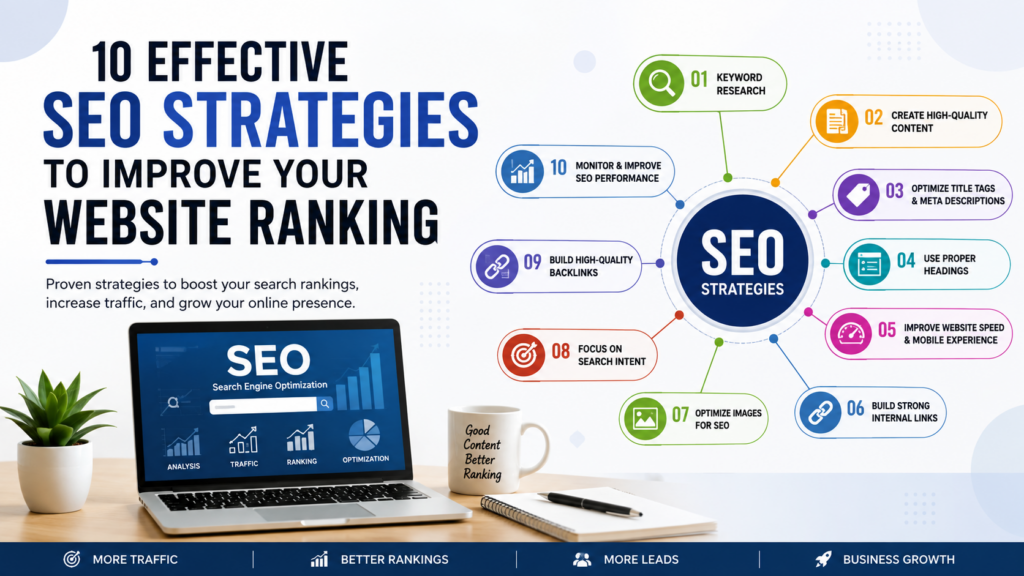
In this blog, we will explore 10 effective SEO strategies to improve your website ranking and build a stronger search presence.
What Is SEO?
Search Engine Optimization (SEO) is the practice of optimizing a website to improve its visibility in organic search engine results.
SEO focuses on both search engines and users. The goal is not simply to add keywords to a webpage, but to create useful, accessible, and relevant content that satisfies what people are searching for.
A successful SEO strategy can include:
- Keyword research
- On-page SEO
- Technical SEO
- Content optimization
- Internal linking
- Image optimization
- Local SEO
- Website performance optimization
- Link building
- Performance tracking
10 Effective SEO Strategies
1. Conduct Keyword Research
Keyword research is one of the most important parts of an SEO strategy.
Before creating content, identify the words and phrases your target audience uses when searching for information, products, or services.
For example, if your website focuses on digital marketing, potential keywords could include:
- Digital marketing services
- Digital marketing tips
- SEO strategies
- Social media marketing
- Content marketing
- SEO tips for beginners
How to use keywords effectively:
- Choose keywords relevant to your topic.
- Understand the search intent behind each keyword.
- Include primary keywords naturally.
- Use related terms and variations.
- Avoid keyword stuffing.
The goal is to create content that answers the user’s question rather than simply repeating a keyword.
2. Create High-Quality, Helpful Content
Content is a major part of a successful SEO strategy.
Search engines aim to provide users with useful and relevant results. Therefore, your content should answer questions, solve problems, and provide genuine value.
Instead of creating short articles just to target keywords, create comprehensive content that covers a topic clearly.
For example, instead of writing a short article titled:
“SEO Tips”
you could create:
“10 Effective SEO Strategies to Improve Your Website Ranking”
A detailed article can cover multiple related questions and provide more value to readers.
Good SEO content should be:
- Helpful
- Original
- Easy to understand
- Well structured
- Relevant to the audience
- Updated when necessary
3. Optimize Your Title Tags and Meta Descriptions
Your title tag and meta description help users understand what your webpage is about when it appears in search results.
Example:
SEO Title:
10 Effective SEO Strategies to Improve Your Website Ranking
Meta Description:
Discover 10 effective SEO strategies to improve website visibility, attract organic traffic, and strengthen your search engine ranking.
A good title should clearly describe the page and naturally include the main keyword.
Your meta description should provide a concise reason for users to click on your result.
4. Use Proper Headings
Headings make your content easier to read and help organize your webpage.
Use a logical structure such as:
H1: Main page title
H2: Main sections
H3: Subsections
For example:
H1: 10 Effective SEO Strategies to Improve Your Website Ranking
H2: What Is SEO?
H2: 10 Effective SEO Strategies
H3: Conduct Keyword Research
H3: Create High-Quality Content
A clear heading structure makes long articles easier for both readers and search engines to understand.
5. Improve Website Speed and Mobile Experience
Website performance is important for both users and search visibility.
A slow website can create a poor user experience and may cause visitors to leave before exploring your content.
To improve website performance:
- Compress large images.
- Use optimized image formats.
- Reduce unnecessary scripts.
- Keep your website design simple.
- Use reliable hosting.
- Check your website on mobile devices.
Your website should also be responsive so that it works properly across smartphones, tablets, and desktops.
6. Build a Strong Internal Linking Structure
Internal links connect one page on your website to another page on the same website.
For example, if you have an article about SEO strategies, you can link to related articles about:
- Digital marketing
- Content marketing
- Keyword research
- Social media marketing
- SEO case studies
Internal linking can help visitors discover more useful content while helping search engines understand the relationships between pages on your website.
Best practices:
- Link to relevant pages.
- Use descriptive anchor text.
- Avoid adding unnecessary links.
- Link from high-value pages to related content.
7. Optimize Images for SEO
Images can improve the visual quality of your website, but they should also be optimized.
Important image SEO practices include:
Use Descriptive File Names
Instead of:
IMG12345.jpg
use something descriptive such as:
seo-strategies-website-ranking.jpg
Add Useful Alt Text
Alt text should describe the image accurately.
Example:
“SEO strategies for improving website ranking”
Compress Images
Large image files can slow down your website. Compress images while maintaining reasonable visual quality.
8. Focus on Search Intent
Understanding search intent is an important SEO technique.
Search intent refers to what the user is actually trying to accomplish when they search for something.
There are several common types of search intent.
Informational Intent
The user wants to learn something.
Example:
“What is SEO?”
Navigational Intent
The user wants to find a particular website or page.
Example:
“Google Search Console”
Commercial Intent
The user is researching products or services before making a decision.
Example:
“Best SEO tools for small businesses”
Transactional Intent
The user is ready to take an action or make a purchase.
Example:
“Buy SEO software”
Creating content that matches search intent can make your pages more relevant to your target audience.
9. Build High-Quality Backlinks
Backlinks are links from other websites pointing to your website.
When reputable and relevant websites link to your content, they can help increase your website’s authority and discoverability.
However, SEO is not about collecting as many links as possible. Focus on earning relevant, natural, and high-quality backlinks.
Some legitimate ways to attract backlinks include:
- Creating original research
- Publishing useful guides
- Creating valuable resources
- Writing expert content
- Building relationships within your industry
- Promoting useful content
Avoid manipulative link-building practices that attempt to artificially influence search rankings.
10. Monitor and Improve Your SEO Performance
SEO is an ongoing process.
After publishing and optimizing your website, monitor performance to understand what is working.
Important metrics include:
- Organic traffic
- Keyword visibility
- Search impressions
- Click-through rate
- Website engagement
- Conversions
- Backlinks
- Indexed pages
Regularly reviewing performance can help you identify opportunities for improvement.
For example, if a blog post receives many impressions but few clicks, you could review its title and search-result presentation.
If a page receives traffic but few conversions, you could improve its content, navigation, or call-to-action.
Bonus SEO Tips for Beginners
If you are new to SEO, start with these simple practices:
1. Focus on One Main Topic
Each webpage should have a clear purpose and topic.
2. Write for People First
Don’t create content only for search engines. Make your content useful and easy to understand.
3. Keep Your Website Organized
Use clear navigation and logical categories.
4. Update Older Content
Review existing articles and update outdated information when appropriate.
5. Be Consistent
SEO results usually take time. Continue creating useful content and improving your website.
Common SEO Mistakes to Avoid
Even a well-designed SEO strategy can fail if common mistakes are made.
Avoid:
- Keyword stuffing
- Copying content from other websites
- Creating content only for search engines
- Using misleading titles
- Ignoring mobile users
- Publishing low-quality content
- Buying spammy backlinks
- Ignoring technical SEO
- Forgetting internal links
- Expecting immediate results
SEO is a long-term strategy, not a quick shortcut.
How Long Does SEO Take to Show Results?
There is no fixed timeframe for SEO results.
The time required can depend on factors such as:
- Website age
- Competition
- Industry
- Content quality
- Website authority
- Technical condition
- Keyword difficulty
- Consistency of optimization
Some pages may begin receiving search visibility relatively quickly, while competitive keywords can take considerably longer.
The best approach is to focus on sustainable improvements rather than expecting instant rankings.
Simple SEO Checklist
Before publishing a webpage or blog post, ask yourself:
- Is the topic relevant to my audience?
- Did I research the target keyword?
- Does the content satisfy search intent?
- Is the page title clear?
- Is the meta description useful?
- Are headings properly structured?
- Are images optimized?
- Did I add relevant internal links?
- Is the page mobile-friendly?
- Is the content original and useful?
- Is the page easy to read?
- Have I checked the page after publishing?
Conclusion
SEO is one of the most effective ways to build long-term organic visibility for a website. By combining keyword research, helpful content, on-page SEO, technical optimization, internal linking, image optimization, search-intent analysis, quality backlinks, and performance tracking, you can create a stronger foundation for your website.
Remember that SEO is not about trying to manipulate search engines. The most sustainable approach is to create valuable content, provide a good user experience, and make your website easy for search engines to understand.
Start with the basics, track your progress, and continuously improve your website.
A consistent and user-focused SEO strategy can help your website attract more relevant visitors and build a stronger online presence over time.